Florida Disaster Programs and Linkage Rules That Can Affect Your Operation
The USDA and FDACS disaster programs play a critical role as Florida’s agricultural sector continues recovering from the severe freeze and the hurricanes of 2023 and 2024. These events created significant operational and financial hardships for producers, threatening the long-term stability of farms and ranches across the region. As producers work to rebuild and move forward, it’s important that they understand program requirements and the types of assistance they may qualify for.
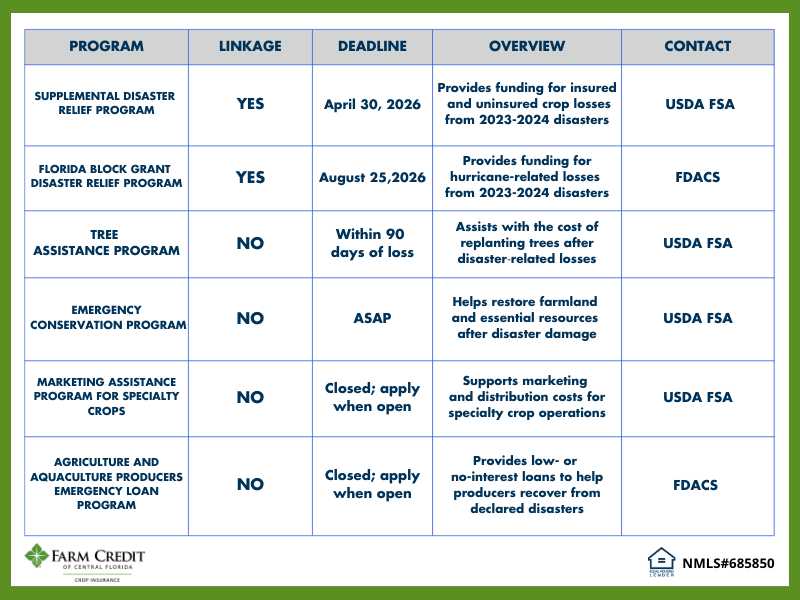
For programs that include linkage, producers need to fully understand the obligations associated with participation. Linkage requires producers to carry crop insurance or NAP coverage at the 60 percent Buy -Up level in the following 2 years. This level of coverage can significantly increase insurance premiums depending on the size, type, and structure of the operation. In some cases, the cost of meeting this insurance requirement may be higher than the amount of disaster assistance a producer receives. For this reason, producers should contact their crop insurance agent to obtain a premium estimate at the required coverage level.
In this blog, we’ll walk through the following programs:
• Supplemental Disaster Relief Program (SDRP) – includes linkage requirements
• Florida Block Grant Disaster Relief Program (FDGDRP) – includes linkage requirements
• Tree Assistance Program (TAP)
• Emergency Conservation Program (ECP)
• Marketing Assistance for Specialty Crops (MASC)
• Agriculture and Aquaculture Producers Emergency Loan Program (AAPELP)
Supplemental Disaster Relief Program
The American Relief Act of 2025 provides $16 billion to help producers recover from revenue, quality, or production losses to crops, trees, bushes, or vines caused by qualifying natural disasters in 2023 and 2024.
SDRP support comes in two parts:
Stage 1
• This support is intended for indemnified losses. It applies to farmers who have already received payment through crop insurance or NAP. USDA uses those insurance records to calculate the SDRP amount.
Stage 2
• This support is intended for non-indemnified losses. It applies to farmers who experienced uninsured, shallow, or quality losses that didn’t trigger crop insurance or NAP payment.
Growers are encouraged to contact their crop insurance agents for premium estimates at the required 60 percent Buy-Up level. Submit your application to your local FSA office by April 30, 2026.
Learn more: Supplemental Disaster Relief Program
Florida Block Grant Disaster Relief Program
The Florida Block Grant Disaster Relief Program supports agricultural producers recovering from hurricane-related damage in 2023 and 2024. The program is designed to help producers rebuild and restore their operations, providing more than $600 million in disaster relief across the state.
Producers may qualify for assistance if they have experienced:
• Infrastructure damage, including losses to greenhouses, barns, irrigation systems, livestock facilities, and internal farm roads.
• Market losses for specialty crops such as strawberries, blueberries, tomatoes, peppers, cucumbers, watermelon, snap beans, and sweet corn.
• Citrus-related damage, including loss of trees, grove damage, and long-term economic impacts.
• Timber loss, including debris cleanup and the cost of replanting, with eligibility beginning at ten or more storm-damaged acres.
Growers are encouraged to contact their crop insurance agents for premium estimates at the required 60 percent Buy-Up level. Submit your application to the FDACS Block Grant portal by August 25, 2026.
Learn more: Florida Block Grant Disaster Relief
Tree Assistance Program
The Tree Assistance Program provides financial support to orchardists and nursery tree growers who lose trees, bushes, or vines due to natural disasters. It helps producers cover the cost of replanting or rehabilitating damaged or destroyed plantings so they can return to production.
To qualify, eligible trees, bushes, or vines must have suffered more than a 15% mortality rate after accounting for normal mortality. Producers must apply through their local FSA office within 90 days of the disaster event or when the loss becomes apparent.
Learn more: Tree Assistance Program
Emergency Conservation Program
The Emergency Conservation Program helps farmers and ranchers recover from natural disasters by providing financial assistance to repair damaged farmland and restore essential resources.
ECP can help with:
• Debris removal from farmland
• Land grading, shaping, or leveling after damage
• Restoring permanent fences damaged by disaster events
• Repairing or restoring conservation structures
• Emergency water conservation measures during severe drought
To qualify, the damage must significantly affect the land’s productivity or threaten natural resources. Producers apply through their local FSA office and are encouraged to do so as soon as possible after the disaster occurs.
Learn more: Emergency Conservation Program
Marketing Assistance Program for Specialty Crops
The Marketing Assistance for Specialty Crops program provides financial assistance to specialty crop producers to help manage higher marketing costs and support the development or expansion of new markets. With $2 billion in available funding, the program helps offset expenses associated with the perishability of specialty crops, including specialized handling, temperature- or humidity-controlled transport, protective packaging, rapid movement to market, and higher labor needs.
Specialty crops supported by MASC include:
• Fresh and dried fruits
• Vegetables, including dry beans, dry peas, mushrooms, and vegetable seed
• Tree nuts
• Nursery crops, floriculture, and Christmas trees
• Culinary and medicinal herbs and spices
• Honey, hops, maple sap, tea
• Turfgrass and grass seed
Producers submit their application to their local FSA office once an application period opens.
Learn more: Marketing Assistance for Specialty Crops
Agriculture and Aquaculture Producers Emergency Loan Program
The Agriculture and Aquaculture Producers Natural Disaster Recovery Loan Program provides low-interest or interest-free loans to help producers recover after a declared natural disaster. Producers can receive up to $500,000 per loan, with terms up to 10 years.
This loan can be used to:
• Restore, repair, or replace essential physical property (fences, equipment, greenhouses, farm buildings)
• Remove vegetative debris from essential property
• Restock aquaculture operations after a loss
Producers may receive one loan per application period, up to two per year, and no more than five within a three-year period. Producers submit their application through the official FDACS Disaster Loan portal once an application period opens.
Learn more: Agriculture and Aquaculture Producers Emergency Loan Program
Why These Programs Matter
These programs play an important role in supporting the long-term stability of agricultural operations. They help producers recover more quickly after disasters by providing timely financial support that reduces downtime and production loss. As growers evaluate their options, it is important to understand each program’s requirements, including linkage and the potential insurance commitments that come with it. By reviewing these details carefully, producers can choose the best programs that support their operation, address immediate recovery needs, and maintain the continuity of their business without taking on unexpected financial strain. If you’re interested in any of these programs, contact your crop insurance agent.
Farm Credit of Central Florida is an equal opportunity provider. In accordance with Federal law and U.S. Department of Agriculture (USDA) civil rights regulations and policies, the USDA, its Agencies, offices and employees and institutions participating in or administering USDA programs are prohibited from discriminating on the basis of race, color, national origin, religion, sex, gender identity (including gender expression), sexual orientation, disability, age, marital status, family/parental status, income derived from a public assistance program, political beliefs, or reprisal or retaliation for prior civil rights activity, in any program or activity conducted or funded by USDA (not all bases apply to all programs). To view this Non-Discrimination policy in more detail, please click here.
CLICK HERE TO DOWNLOAD THE QUICK FACT SHEET
Ready To Get Started?
Get in touch with us and we'll be happy to help you through the loan process.